Friday, August 29, 2014

Roof Talk-101 Focus On Skylights, Daylighting & Solar Collectors

Roof Talk-101  Focus On Skylights, Daylighting & Solar Collectors


Standing Seam Solar Systemsky
MetalTech
MT Solar PV Standing Seam roofing utilizes photovoltaic technology to provide energy to the building. The standing seam profile combined with the solar cells creates an excellent eco-friendly solution for any building project. Because the paneling used is fabricated with sustainable materials such as zinc, this roofing application is ideal for use in green construction projects as well. 


sky1Solar Mounting and Racking Systems
TRA-Mage
Each and every component in the TRA-Mage Solar Mounting line is designed to create a perfect foundation for solar panel systems. The company offers flush mount – shingle, slate, standing seam and tile, ballasted, elevated, ground mount and awning solutions.


Integral Curb Skylight With Guardsky2
Plasteco, Inc.
Plasteco offers a complete line of commercial, industrial and architectural skylights in acrylic and glass glazing. Pictured is Model 209 with an integral curb and FallGuard® skylight screen, which can also be installed on existing skylights to meet OSHA 1926.501. The models are available for acrylic dome skylights, standing seam skylights and corrugated fiberglass panels used in metal roofs. 


sky3Translucent Skylights and Wall Systems
Major Industries, Inc.
Guardian 275® translucent skylights and wall systems provide energy-saving, glare-free natural light while offering enhanced thermal performance over traditional daylighting systems. They feature a lightweight sandwich panel design with advanced face sheet technology and built-in moisture management that ensures long-term performance — all backed by industry-long warranties.


Premium Daylighting Solutionssky4
Firestone Building Products
Firestone SunWave SMRT™ (Solar Motion Response Technology) Daylighting System provides better performance and sustained savings. Using the latest in GPS technology and mirrors, SunWave SMRT actively tracks the sun’s movement to bring high levels of diffused natural light into buildings, allowing businesses and schools to reduce their energy use for lighting by up to 50-80 percent. 


sky5Prismatic Skylight
Carlisle-SynTec
The SunWeld™ Prismatic Skylight offers maximum diffused light resulting in increased energy savings and value. The unique computer-designed tri-arch dome shape manufactured from two layers of high-impact acrylic sheet with a K 12 prism pattern maximizes diffused Visible Light Transmission (VLT) and ensures superior mechanical and thermal properties.


Freestanding Skylight Fall Protectionsky6
Garlock Safety Systems
Sky-Dome™ is one-piece, freestanding, lightweight system that prevents people from falling through skylights. To use, simply set in place and walk away — no mechanical attachment to the skylight or roof is required. Features include all-steel construction and a powder coated finish in safety yellow. BIM objects are available for free download at ARCAT. 


sky7Solid-State Skylights
VTECH Industries
VTECH Industries’ patented materials and manufacturing processes offer the first and only fully encapsulated, Solid-State Skylight that exceeds all required codes (including Miami-Dade County), surpasses all industry standards, and is thermal efficient, sustainable product that will not leak, warp, or require any maintenance, according to the company.


Prismatic Skylightssky8
Acralight
Acralight now features the AcraStar XL Prismatic Skylight and the AcraStar XL Plus with Infra-red, which features heat reduction technology for energy efficiency. The company also offers the Vertex OSHA Compliant Skylight, the NanoStar Skylight with Lumira Aerogel translucent insulation, and the AcraStar HR Series hurricane resistant Miami / Dade County Approved skylights.

sky9Solar Roofing System
CertainTeed
The Apollo® Solar Roofing System features highly efficient, integrated polycrystalline solar panels. Each slim, 12-pound module features 14 high-efficiency polycrystalline silicon solar cells that absorb sunlight and convert it into electricity. Apollo is durable, resistant to wind uplift, and can easily be installed on an existing or new roof. It is offered in pre-engineered kits containing all components necessary for installation.


Roof Hatch With Skylightsky10
Bilco
Bilco’s Type GS roof hatch offers the security and convenience of a roof hatch with the added benefit of a skylight. The clear polycarbonate dome does not require a fall protection screen and is coated for UV resistance. Hatches feature aluminum construction, full gasketing for weathertightness, and lift assistance for easy one-hand operation. 


sky11Solar Thermal Collectors
Sun Master
Sun Master unveils the next development in solar thermal technology and presents a new collector that includes all necessary installations and can be very simply mounted on any roof — with no need to install a separate electricity or water supply.


Tube Skylightsky12
Owens Corning
Owens Corning recently introduced the Illuminator™ Tube Skylight, a cost-effective alternative to traditional skylights. The Illuminator Tube Skylight provides up to 500 watts of evenly-distributed natural light and is backed by a Limited Lifetime Warranty, offering homeowners complete coverage against manufacturing defects for as long as they own their home. The one-piece seamless flashing is designed to prevent leaking and is easy to install, with standard installation taking 1-3 hours. A Solar Powered Dimmer is available for all 10-inch Illuminator™ Tube Skylight kits.

ROOFTEC-LLC and ROOFGUARD-LLC has been installing commercial roofing systems for over 30 years. We have the solutions you are looking for if you desire a new commercial roof or need a re-roof. ROOFTEC-LLC only uses the best products and installation practices to insure you have a worry free commercial roof. For more information visit us at. www.rooftec-llc.com and we also invite you to Like Us on our RoofTec-LLC Facebook Page .

Wednesday, August 20, 2014

Roof Talk-101 Top Five Benefits of a Green Roof

Roof Talk-101 Top Five Benefits of a Green Roof

Green roofs can be installed on a wide range of buildings, from industrial facilities to private residences. They can be as simple as a 2-inch covering of hardy groundcover or as complex as a fully accessible park complete with trees. Green roofs are becoming popular in the United States, with roughly 8.5 million square feet installed or in progress as of June 2008.2A green roof, or rooftop garden, is a vegetative layer grown on a rooftop. Green roofs provide shade and remove heat from the air through evapotranspiration, reducing temperatures of the roof surface and the surrounding air. On hot summer days, the surface temperature of a green roof can be cooler than the air temperature, whereas the surface of a conventional rooftop can be up to 90°F (50°C) warmer.1

Benefits and Costs

In addition to mitigating urban heat islands, the benefits of green roofs include:
  • Reduced energy use: Green roofs absorb heat and act as insulators for buildings, reducing energy needed to provide cooling and heating.
  • Green, or Eco, roof in Portland, Oregoni
    This apartment building in Portland, Oregon, is among the 6 acres (24,300 m2) of green roofs in the city, as of 2007. Many roofs remain candidates to become green roofs. (Photo courtesy of Portland Bureau of Environmental Services)
    Reduced air pollution and greenhouse gas emissions: By lowering air conditioning demand, green roofs can decrease the production of associated air pollution and greenhouse gas emissions. Vegetation can also remove air pollutants and greenhouse gas emissions through dry deposition and carbon sequestration and storage.
  • Improved human health and comfort: Green roofs, by reducing heat transfer through the building roof, can improve indoor comfort and lower heat stress associated with heat waves.
  • Enhanced stormwater management and water quality: Green roofs can reduce and slow stormwater runoff in the urban environment; they also filter pollutants from rainfall.
  • Improved quality of life: Green roofs can provide aesthetic value and habitat for many species.
ROOFTEC-LLC and ROOFGUARD-LLC has been installing commercial roofing systems for over 30 years. We have the solutions you are looking for if you desire a new commercial roof or need a re-roof. ROOFTEC-LLC only uses the best products and installation practices to insure you have a worry free commercial roof. For more information visit us at. www.rooftec-llc.com and we also invite you to Like Us on our RoofTec-LLC Facebook Page .

Wednesday, August 13, 2014

Roof Talk-101 There Are Green Roofs and Then There Are Smart Green Roofs

Roof Talk-101 There Are Green Roofs and Then There Are Smart Green Roofs

ByRob O'Flanagan
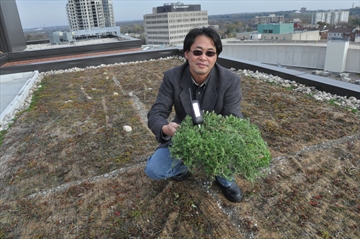
GUELPH — There are some growing roofs in Guelph — one over a Hillside Festival stage, another atop city hall. But the University of Guelph and the global software company SAP are taking the concept up a high-tech notch.
Together they are conducting research and development on 'smart' green roofs — roofs made from special plants and special soil that absorb storm water, regulate building temperatures, and use automated monitoring and maintenance systems.
If widely used, the roofs could vastly reduce air conditioning costs and storm water management costs, and prolong the life of roofing decks, developers of the concept say.
Guelph's Gummer Building, headquarters of Skyline Group of Companies, is growing one of two pilot roofs in the Guelph area. The other is on a farmhouse north of Ariss.
The idea was developed by Youbin Zheng, University of Guelph associate professor in the School of Environmental Science, and chair of the Environmental Horticulture and Vineland Research and Innovation Centre.
Zheng was up on the Gummer Building roof recently conducting a quick overview of downtown Guelph rooftops, pointing out that when a hard rain falls, all the water runs off roofs, down streets and into storm drains. When torrential rains fall, as they did in Toronto and Calgary over the summer, systems become overloaded.
"It costs tons of money to manage storm water," said Zheng, who was joined on the roof by research associate Greg Yuristy, and U of G Catalyst Centre industry liaison Tyler Whale. The Catalyst Centre is working to commercialize the smart green roof.
The green roof, Zheng said, can eliminate vast amounts of storm water by absorbing heavy rains and using them to nourish carbon absorbing plants. Not only do the roofs have the potential to reduce municipal infrastructure costs, they act as very efficient insulation, reducing air conditioning costs by up to 75 per cent.
The artificial soil the plants grow in can incorporate waste materials, such as crushed bricks or even crushed zebra mussels, he added.
SAP's Waterloo office is partnering on the project. Bob Campagnolo is SAP Canada's consultant in the emerging technologies group.
"We want to make the performance of the green roof and the maintenance of it as automated and as easy as possible," he said.
Sensors of all kinds have become ubiquitous in society, he said, and SAP wants to take advantage of the technology to remotely monitor the health of a green roof.
"Typically green roofs are installed and there might be some sort of manual maintenance procedures in place to make sure the roof remains healthy," he said. "What we're going to do is automate that."
Various sensors, some of which are solar powered, will measure a number of variables that contribute to the health of the roof, including sunlight, temperature and humidity, nutrient levels and soil moisture.
"They'll transmit that data to a consolidation point, and the availability of the data from the sensors allows you to track the performance of the roof remotely," Campagnolo said. "Not only will the data tell you if you need maintenance, but we can automate the maintenance as well."
Jason Ashdown is chief of operations with the Skyline Group. He said his company, SAP and the university want to know if the green roof will cost roughly the same as conventional flat roofs. There are indications the costs will be comparable, and if that is the case the green roofs may be a viable alternative for the company, which is one of Canada's largest multi-residential real estate owners.
"We decided to try it on one of our newest buildings, join up with the U of G and see how it looks and how it works," Ashdown said. "We'll make judgment on it in a year or so."
With three million square feet of commercial roof surface, the company spends a great deal on roof repair and replacement, Ashdown said. If a green roof can cut down on those costs, it will be a financial benefit to the company.
"We like to do things that help the environment and reduce our footprint," he added.
Tyler Whale, of the Catalyst Centre, patents and markets U of G innovations. He said the Skyline roof in downtown Guelph is the first smart green roof project on a flat roof.
"Having Skyline as part of the team is really nice," he said. "They are a local company that cares about trying to advance research and development within their community, and within the environmental sustainability framework, and at the same time save money. These are business people who want to make the right choice and make their business more profitable. This is one of those technologies that can do that."
Whale said smart green roofs make good business sense because they prolong the life of roof decks on buildings and improve the efficiency of solar panels.
Work remains to be done on the data collecting system and the structure of the roofs, Campagnolo said. Roughly another year is needed on the research and development stage, and other early adopter customers will have to be lined up before the system goes commercial.
Green roofs replace conventional roofing material, such as asphalt shingles or tin. A layered system, a green roof begins with a waterproof membrane, followed by a drainage layer, a layer to keep dirt and grit out of the drainage layer, the artificial soil and the plants themselves.
The plant sedum is often used on green roofs because of its water retention properties, but water evaporation, necessary for keeping roofs cool, is not one of sedum's strengths, Campagnolo said. U of G scientists are studying other plant combinations that would be more effective.
ROOFTEC-LLC and ROOFGUARD-LLC has been installing commercial roofing systems for over 30 years. We have the solutions you are looking for if you desire a new commercial roof or need a re-roof. ROOFTEC-LLC only uses the best products and installation practices to insure you have a worry free commercial roof. For more information visit us at. www.rooftec-llc.com and we also invite you to Like Us on our RoofTec-LLC Facebook Page .

Tuesday, August 5, 2014

Roof Talk-101 6 Busted Green-Roof Myths


Roof Talk 101  6 Busted Green-Roof Myths


Mariana Pickering, Houzz Contributor and Architect
Green roofs, living roofs, vegetated roofs, ecoroofs — whatever you want to call them, they are sprouting up everywhere lately, including atop residential homes. And with that increase in popularity comes general assumptions and misconceptions. For example, that green roofs are only for ecobuffs, they’re high maintenance and they’re experimental and risky. All untrue.
Let’s take a look at some common green-roof myths and see if they, er, hold any water.
The Basics
A green roof is simply one that fosters the growth of vegetation. It is made of a waterproofing layer, a root barrier, a drainage system and growing medium for the plants. “Intensive” green roofs, or roof gardens, can be accessible and can include much larger plants and even water features.
An “extensive” green roof, on the other hand, is a thinner, lighter, version that looks more similar to a standard roof. It can be sloped or flat. Often it will be planted with sedum (stonecrop). Many “semi-intensive” green roofs are home to an array of plant species, including native grasses and flowers.
More: Discover inspiring landscaping ideas and find a top local landscape contractor or residential landscape architect to plan your garden landscape.
Common Myths

Myth No. 1: Green roofs are a new and experimental part of the green trend.
When do you think the residential green roof in this photo was installed? Five years ago? Ten? Maybe 20? This green roof has been protecting this German residence since the 1940s — more than 70 years ago!
Last May I was able to attend the International Green Roof Association’s conference in Hamburg, Germany. As part of the conference program, we visited the small community of Wohldorf-Ohlstedt. This roof and others like it were constructed in 1943 in one of three Norwegian settlements. The neighborhood was intended to be a social housing option for the needy, including former concentration camp prisoners. It later became a middle-class suburb, with the green-roofed houses becoming quite sought after but rarely available.
Green roofs have been around for centuries. It’s the execution of them that has become more technical of late, allowing for thinner and lighter roof profiles.
Myth No. 2: A green roof is only for a green building.
Certainly there are many green building certifications that award points for the installation of a green roof. The environmental benefits are undeniable. However, even homes that don’t have a specific eco objective can benefit from the aesthetic and economical aspects of having an extended garden space.
Green roofs can save you money, too. In Germany (where green-roof research has the longest history), extensive green roofs are used as an economic alternative to other options. They have been shown to reduce heating and cooling costs, reduce stormwater runoff (and therefore flooding), and provide added commercial space, which in turn increases the market value of a property.
The advantages of stormwater mitigation have been noticed by the city of Portland, which now runs the Portland Ecoroof Program, providing incentives to developers who design vegetated roof systems.
Myth No. 3: Green roofs may look nice, but they can cause structural problems and leakage.
This is perhaps one of the most cited concerns of clients. Let me be clear: A leaky roof is independent of whether it’s a green roof or a traditional roof. It has to do with the installation and design specification of the structure. All roofs must have a proper waterproofing membrane, green roofs included.
There is no evidence to suggest that green roofs are more susceptible to leaking. In fact, some studies suggest that the longer life cycle of a green roof is due to the protection of the waterproof membrane from ultraviolet sunlight. The plants and substrate act as a natural barrier to weathering.
A properly designed green roof will also have a root barrier to stop plants from trying to root too deep.
This homeowner elected to have his vegetable garden on the roof (perhaps to keep it safe from hungry animals).
Newly constructed homes must meet the requirements of the designed loads, so as long as your architect and structural engineer are on the same page about your desires for a green roof, there should be no problem for a new home to meet the structural requirements.
For retrofitted green roofs, you have to be a bit careful. Requirements will depend a lot on what part of the country you live in and what kinds of loads your home was originally designed to sustain (snow, wind, rain etc.).
Myth No. 4: Green roofs are difficult and costly to irrigate.

Many people think that a green roof has to be planted with sedum or other succulents because it’s impossible or prohibitively expensive to irrigate a green roof. The reality is that all green roofs require irrigation in the beginning while the roots of the plants are establishing themselves (with the exception of pregrown mats made offsite). The reason that water-storing plants are so popular is because they are beautiful and hardy enough to stand up to the tough conditions of a roof.
However, sometimes combining these with other types of vegetation, such as native grasses, can be a good way to introduce more diversity and increase the aesthetic charm of the roof. Intensive roofs, or roof gardens, are the perfect example of this. Some even have bushes and trees.
The irrigation needs of a green roof are specific not only to plant selection, but also to the local climate. I recently talked with Casey Boyter of Casey Boyter Gardens in Austin, Texas, about how to design green roofs for the long, hot, Texas summers, where sometimes temperatures stay over 100 degrees Fahrenheit all summer long.
She pointed out that when it finally does rain, it rains a lot. Therefore it is not only important to select drought-tolerant plants that can make it through the heat waves, but it’s also necessary to design a thicker substrate (growing medium), made of materials that can absorb large amounts of water. The drainage layer may also have deep pockets in it (similar to an egg carton) to store water that will then be released back to the plants during the next heat wave.
The need for irrigation is cut down considerably with these features. In fact, many green roofs require no additional water once they are established. They become an integral part of nature’s water cycle for that particular site.
“If we begin to think about each site as self-regenerative and consider closed-loop cycles for our water, I assure you we would be further away from the increasing desertification of our landscapes,” Boyter says. “Green roofs, living architectural systems, are a tool to increase the quality of our lives as well.”
Mark Garff at The Watershed Company in Seattle has a similar approach. The roof gardens in this photo were specifically designed to attract insects, particularly pollinators like bees, he says. “We created additional planting depth to increase species diversity,” he says.
This means that a green roof can act as an extension of the natural landscape on and around the site. The roof then becomes part of a healthy and balanced micro-ecosystem, supporting biodiversity.
“Long-term irrigation of a green roof is no more costly than any other planting area,” he says. To offset the costs, the irrigation water can be harvested as rainwater, as is the case for the green roof in this photo.
Myth No. 5: You can just put some dirt on your roof to make your own green roof.
Stop! Don’t do it. A well-designed green roof is made of much more than good potting soil. Often it doesn't even include soil, but instead calls for perlite or other porous lightweight materials.
As I mentioned before, the structure of your home needs to be analyzed to see if it can handle the load of a rain-soaked green roof. The specific climate of your site will need to be considered, and plant selection and drainage systems will need to be designed.
This doesn't mean that all green-roof systems have to be built in, however. Some professionals in North America are using modular systems in their design specifications. For example, Aaron Kang-Crosby at Spore Design says the company used a modular system by LiveRoof for this roof deck, with sedum already grown in from a local nursery. (I personally have not seen these systems used in Europe, and I’m curious to hear what readers have to say about their performance.)
Myth No. 6: A green roof is just too expensive and complicated.
It seems a lot of people are intimidated by green roofs because they don’t know where to start or how much it will cost them.
“Choosing the right team of professionals is one way to keep both short-term and long-term costs down,” Boyter says. You can start by asking your architect or checking the database of accredited green-roof professionals in your area.
The Environmental Protection Agency estimates the cost of a green roof at $10 to $25 per square foot. Obviously, this price is highly variable, depending on whether you want an inaccessible sedum roof or an accessible roof garden.

The warranties on the building products used in a green roof are similar to those for all of the other building products in a home. They must be installed according to the manufacturer’s specifications by a qualified professional.
Every green roof installation should come with a service contract to address annual maintenance. The extent of that maintenance will depend a lot on how you want to use your green roof.
According to Boyter, the maintenance plan should be part of the initial design and installation, with a two-year and a five-year plan included, or perhaps an even longer plan in certain circumstances.The life spans of residential green roofs are still largely undocumented, but some professionals say they can be double the lifespan of a traditional roof. The green roofs of Rockefeller Center in New York City, for example, have the same waterproofing membranes that were installed in the 1930s.
ROOFTEC-LLC and ROOFGUARD-LLC has been installing commercial roofing systems for over 30 years. We have the solutions you are looking for if you desire a new commercial roof or need a re-roof. ROOFTEC-LLC only uses the best products and installation practices to insure you have a worry free commercial roof. For more information visit us at. www.rooftec-llc.com and we also invite you to Like Us on our RoofTec-LLC Facebook Page .
Wednesday, July 16, 2014

Roof Talk-101 Recycling Electronics

Roof Talk- 101  Recycling Electronics


Electronic Waste, or eWaste or as it is called by those in the recycling trade, is more and more of an issue in the waste stream.  Computers, mp3 players, phones, you name it – these items are produced in larger and larger quantities, and it all has to end up somewhere.  According to Compucycle, 135 million phones and 31 million computers are disposed of annually in the US alone.  Many of these gadgets contain hazardous materials, such as lithium batteries, that can leach into groundwater or cause various other problems.  Plus, many of the materials used in electronics, such as gold and copper, are valuable and in short supply.  So you can see why it is important not to just toss old electronics in the trash; but at the same time, it can be hard to find a suitable and safe site to properly recycle old electronic items.

You need to recycle electronics, Goodwill is the best option in my experience.  You can bring almost any old electronic item there (don’t forget old extension cords, they can be recycled too, and contain valuable copper) for recycling.  In some cases you may need to pay or make a donation, particularly for hard-to-recycle items like older-style CRT monitors, which contain leaded glass.  Staples, Best Buy, and many other electronics recyclers offer programs too.  You may also check greenergadgets.org, a site maintained and supported by the Consumer Electronics Association supports shinglerecycling.org!).
Do you have old electronics that need recycling?  Have you had challenges finding a suitable place? 

Tuesday, July 8, 2014

The History and Evolution of Building Fasteners

The History and Evolution of Building Fasteners

By Tom Hulsey
Fasteners and fastening systems have evolved steadily over time.  History has led us from the use of nails as the fastener of choice to today’s self-drilling screws as the most versatile means of securing one piece of material to another in the steel building and post framed building industry.
Nails, as a means of fastening wooden objects, date back to approximately 3400 BC in ancient Egypt.  The term “penny” probably originated in medieval England to describe the price of 100 nails.  The “d” that is used as abbreviation for penny is derived from Latin for the name of the Roman coin, Denarius. 
Until the early 1800’s, nails were made by hand.  Around 1800, cut nails (square nails) were made from wrought iron.  Around 1860’s, wire nails were introduced and by early 1900’s, 90% of all nails were wire nails.
Screws, on the other hand, date back to 3rd Century BC in Greece.  By the 1st Century BC, screws were commonly used throughout the Mediterranean area in screw presses in the processing of olive oil and grapes. 
The spiral thread has proven over time to be an effective means to provide the force needed in order to perform specific tasks.  Just as nails were originally made by hand, screws were likewise made by hand for use in the assembly of materials to form a secure attachment of one piece to another.   Originally, there were no standards to guide the making of the screw.  Consequently, there was no chance of having screws to be interchangeable from one application to another.  The screw, therefore, was a custom fabrication for one specific application.
The development of screws and screw thread forms occurred around 1800 with the development of a modern screw cutting lathe.  Screws could be made more precisely and therefore could be produced much faster than before.  Consequently, the development and standardization of thread forms became important for reproducibility and interchangeability in use.
In the late 1860’s and early 1870’s, the US Standard Thread was created.  Thread designs and thread forms continued to evolve.  Sometime around 1916, the SAE Standard (Society of Automotive Engineers) was established in order to augment the US Standard.  This standard defined thread forms and specifications for threaded fasteners for general use. These standards were later adopted by ANSI (American National Standards Institute).  IFI (Industrial Fasteners Institute) is also a standards publisher that defines thread forms for fasteners.
My first involvement with threaded fastener standards was in the mid 1960’s.  At that time, the most common fastener used in the metal building industry to attach roof and wall sheeting to the girts and purlins was a #1/4-14 Hex Head Type B self-tapping fastener.  The roof sheeting side laps used a #14-10 Hex Head Type A fastener to secure the laps.  Both fastener types required a pre-drilled hole in the assembly in order to be installed.  Installation required two tools and often two workers to install the fasteners; one to drill the holes and a second worker to install the fastener. 
By the late 1960’s, self-drilling fasteners were making their way into the metal building market.   Self-drilling fasteners were new and were also relatively expensive as compared to the self-tapping Type A and Type B fasteners that were commonplace at the time.  The first self-drilling fastener to be introduced was described as a “milled point” self-drill.  That name described the operations required to create the drill point on the end or the screw.  A typical metal building self-drilling fastener required a minimum of four cutting (milling) operations to produce the drill point geometry. 
By the late 1960’s and early 1970’s, a new technology self-drilling point was introduced to the metal building industry.   It was described as a “pinched point” (cold forged) self-drill.  This new point required only one operation to form (pinch) the point on the end of the fastener.  That process employed the use of a machine equipped with hardened dies that were configured to match the desired shape of the point.  As the fastener passed into position, the dies were closed and the point was cold formed on the screw in one operation.  This process was faster and more consistent in production of the self-drilling screw.
The obvious advantage of using the self-drilling fastener was the reduction in the overall time and cost of installing the fastener.  The self-drilling fastener did not require a pre-drilled hole to be installed.  It was still a hard sell in the early years because the self-drilling screws were considerably more expensive to purchase.  Eventually, the economics of a one-man operation to install a fastener became evident. Today, the self-drilling fasteners are used almost exclusively for securing wall and roof sheeting to girts and purlins in the metal building industry. 
Until the mid 1970”s, nails were the fasteners of choice for attaching metal sheeting to wood framed buildings.  The early nails were equipped with malleable lead heads or a loose disc of rubber under the nail head to effect a seal at the nail penetration through the metal panel.  The nails were generally placed at the high point of the corrugations to reduce the chance of leaks when the nails worked loose.  One building owner once said, “Put the nails in the top where the water doesn’t run.”  With the introduction of screw fastening and high performance EPDM sealing washers, fastening in the flat portion of the panel became the best location for both structural and weatherproofing integrity of the roof system. 
Self-drilling fasteners continue to evolve in form and in function.  Continually advancing technology in the design of heading, threading, and pointing equipment has produced cost effective solutions for virtually every fastening challenge.  Specifically designed thread forms provide higher strength structural connections at the purlin/ girt /metal panel connection.  New alloys are being developed in conjunction with innovative hardening processes to provide a new generation of self-drilling fasteners with exceptional performance capabilities. Improved finishing technology has provided exceptional corrosion protection and appearance of the installed fastener.  Enhanced UV and Ozone resistant metal sheeting finishes and “Green” technology continue to improve the overall quality of the building structure.  Proper installation tools for fastener installation are now on the forefront of the development challenge. 

Tuesday, July 1, 2014

Roof Talk-101 Three Key Questions About Green Roofing


Roof Talk-101 Three Key Questions About Green Roofing

by: Jim Hoff

Recently, I was asked to participate in an online Q&A session about sustainable roofing. The questions I received were outstanding, so I thought every Roofing Contractor reader could benefit from a brief recap of the session, which is available free of charge in the “test drive” section of my course titled “Commercial Roofing Boot Camp.

Q. When I talk to building owners and architects who are looking for LEED certification, the only thing they want to know about the roof is whether or not it’s white because white roofs get a LEED credit. Isn’t this a shortsighted way to design and specify a roof?


A. Yes, it is very shortsighted; and I’ll be the first to admit that changing the narrow focus on white roofs supported by the LEED heat island credit is very difficult. Probably the best tool available to improve the discussion about roof surface color is the RoofPoint program developed by the Center for Environmental Innovation in Roofing. RoofPoint recognizes the “greenness” of roofs using 23 different credits, and only one of these credits addresses roof surface color. And even the roof surface color credit in RoofPoint allows the use of darker roofs in the coldest climates and provides for other cool roof alternatives such as ballast. It’s a great program to educate building owners and help demonstrate that you can be a valuable expert on the best in sustainable roofing practice.

Q. How can I go about integrating green into my business?


A. I think it’s important to integrate green into your business in three basic ways. First, focus on one or two sustainable roofing strategies that could provide real value for your customers. As an example, if you re-roof a lot of warehouses, consider integrating daylighting (skylights) into your roofing proposals. There are many excellent design tools available to help you get started, and the payback is fast, especially if you can integrate the skylights into the lighting controls. For businesses with high hot water needs, such as laundries, car washes, etc., rooftop solar thermal can also be a profitable add-on to your next roofing project.

Next, look for ways to get your employees involved. Do you keep track of waste and scrap returned from jobsites, and do you have a plan to recycle or re-use them? Do you know how this year’s carbon footprint from your trucks and equipment compares to previous years, and do you have an incentive program to reduce fuel (carbon) usage? Finally, emphasize that worker safety is just as green as any other green practice. After all, green is fundamentally about people. Consider what you could do to help your community save energy and reduce waste. When you do this, it not only will help reinforce your in-house green programs, but it also will increase your company’s reputation as a sustainably-minded business.

Q. Are you concerned that some new “green” roofing products aren’t yet proven to be durable?


A. Yes, I do have concerns. My own roofing career started during the single-ply revolution of the 1970s and 1980s, and I know from hard experience how difficult it is to integrate new technologies into proven roofing practice. But I also recognize that time doesn’t stand still, and we need to find ways to use new green roofing products without exposing ourselves and our customers to potential risks. Here are three of my green performance tips:

1. Learn as much as you can about vapor retarders and how they need to be installed to actually work. Along with increased interest in cool roofs which tend to accumulate condensation and the use of air barriers to tighten up the building, we unfortunately may see premature roof failures due to long-term moisture damage — unless we work harder to keep the moisture out in the first place.

2. Given the significant increase in code-mandated insulation thicknesses, cover boards are almost mandatory to protect all that expensive R-value from damage. And the same goes for thermal barriers beneath the insulation, which can serve as a very effective platform for installing air barriers and vapor retarders.


3. With reductions in the VOC content of roof adhesives, cold weather application of fully adhered roofs is very, very tricky. So, invest in insulated “hot boxes” to store adhesives and keep them at a decent temperature on the roof. And make sure your crews are up to date on the latest technical bulletins about cold weather construction from your suppliers.

ROOFTEC-LLC and ROOFGUARD-LLC has been installing commercial roofing systems for over 30 years. We have the solutions you are looking for if you desire a new commercial roof or need a re-roof. ROOFTEC-LLC only uses the best products and installation practices to insure you have a worry free commercial roof. For more information visit us at. www.rooftec-llc.com and we also invite you to Like Us on our RoofTec-LLC Facebook Page .

Recently, I was asked to participate in an online Q&A session about sustainable roofing. The questions I received were outstanding, so I thought every Roofing Contractor reader could benefit from a brief recap of the session, which is available free of charge in thetest drivesection of my course titledCommercial Roofing Boot Camp.To view it, just log on after clicking this link:  http://bit.ly/roofingtest.

Q. When I talk to building owners and architects who are looking for LEED certification, the only thing they want to know about the roof is whether or not its white because white roofs get a LEED credit. Isnt this a shortsighted way to design and specify a roof?
A. Yes, it is very shortsighted; and Ill be the first to admit that changing the narrow focus on white roofs supported by the LEED heat island credit is very difficult. Probably the best tool available to improve the discussion about roof surface color is the RoofPoint program developed by the Center for Environmental Innovation in Roofing. RoofPoint recognizes thegreennessof roofs using 23 different credits, and only one of these credits addresses roof surface color. And even the roof surface color credit in RoofPoint allows the use of darker roofs in the coldest climates and provides for other cool roof alternatives such as ballast. Its a great program to educate building owners and help demonstrate that you can be a valuable expert on the best in sustainable roofing practice.

Q. How can I go about integrating green into my business?
A. I think its important to integrate green into your business in three basic ways. First, focus on one or two sustainable roofing strategies that could provide real value for your customers. As an example, if you re-roof a lot of warehouses, consider integrating daylighting (skylights) into your roofing proposals. There are many excellent design tools available to help you get started, and the payback is fast, especially if you can integrate the skylights into the lighting controls. For businesses with high hot water needs, such as laundries, car washes, etc., rooftop solar thermal can also be a profitable add-on to your next roofing project.
Next, look for ways to get your employees involved. Do you keep track of waste and scrap returned from jobsites, and do you have a plan to recycle or re-use them? Do you know how this years carbon footprint from your trucks and equipment compares to previous years, and do you have an incentive program to reduce fuel (carbon) usage? Finally, emphasize that worker safety is just as green as any other green practice. After all, green is fundamentally about people. Consider what you could do to help your community save energy and reduce waste. When you do this, it not only will help reinforce your in-house green programs, but it also will increase your companys reputation as a sustainably-minded business.

Q. Are you concerned that some newgreenroofing products arent yet proven to be durable?
A. Yes, I do have concerns. My own roofing career started during the single-ply revolution of the 1970s and 1980s, and I know from hard experience how difficult it is to integrate new technologies into proven roofing practice. But I also recognize that time doesnt stand still, and we need to find ways to use new green roofing products without exposing ourselves and our customers to potential risks. Here are three of my green performance tips:
1. Learn as much as you can about vapor retarders and how they need to be installed to actually work. Along with increased interest in cool roofs which tend to accumulate condensation and the use of air barriers to tighten up the building, we unfortunately may see premature roof failures due to long-term moisture damage — unless we work harder to keep the moisture out in the first place.
2. Given the significant increase in code-mandated insulation thicknesses, cover boards are almost mandatory to protect all that expensive R-value from damage. And the same goes for thermal barriers beneath the insulation, which can serve as a very effective platform for installing air barriers and vapor retarders.
3. With reductions in the VOC content of roof adhesives, cold weather application of fully adhered roofs is very, very tricky. So, invest in insulatedhot boxesto store adhesives and keep them at a decent temperature on the roof. And make sure your crews are up to date on the latest technical bulletins about cold weather construction from your suppliers.